
Key Characteristics of HUSCH High-Performance Brake Pads
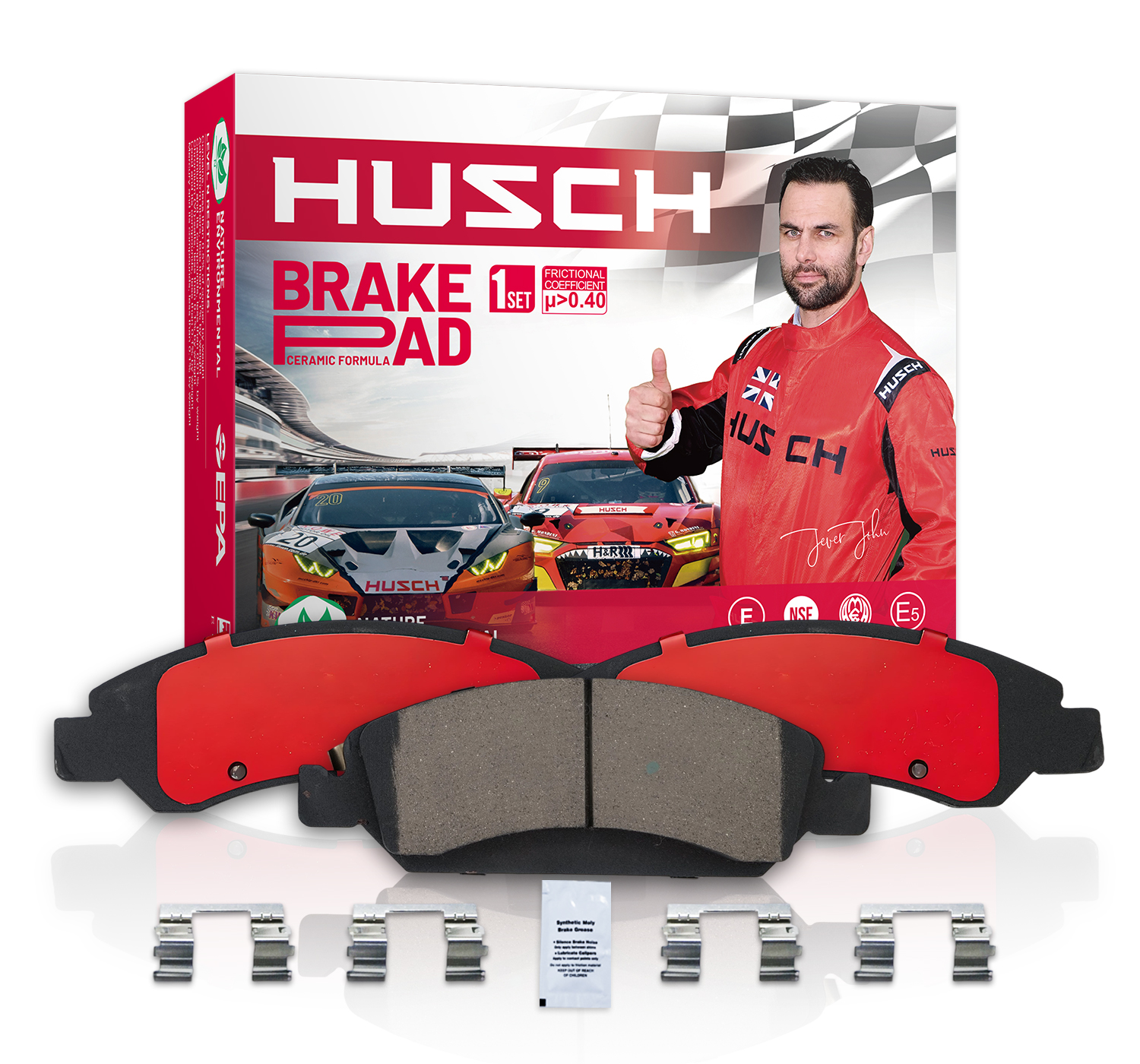
When evaluating brake pads, there are indeed seven critical areas of focus: cold performance, hot performance, operating temperature range, pad wear, rotor wear (depending on the type of brake pad you choose), and—depending on your application—noise and dust levels may also be significant.
First, let's take a look at the structure of a brake pad.
- Chamfer: This improves initial engagement and also helps reduce brake noise.
- Slots: Serve two purposes: first, to help clear debris from the pad or rotor; second, to provide room for expansion when the pad heats up, preventing internal cracking.
- Shims: Prevent excessive heat transfer to the caliper.
- Backplate: Helps secure the brake pad more firmly within the caliper.
- Larger Pads: If you upgrade to a larger caliper with more pistons, you can use larger brake pads.
Are larger brake pads always better?
The answer is No. Larger pads mean more friction material and better resistance to heat fade. Heat is also distributed over a larger area. However, it's important to note that with larger pads, less airflow reaches the covered portion of the rotor, which can affect rotor cooling. Therefore, bigger pads are not necessarily better.
Brake pads come in various formulations: asbestos, ceramic, semi-metallic, carbon-carbon, etc. For consumers, understanding this in detail isn't crucial.
Different brake pads exhibit different characteristics, largely determined by material selection.
For example, OEM (Original Equipment Manufacturer) brake pads have a high friction coefficient at low temperatures, which suits the driving characteristics of everyday vehicles. However, when temperatures rise beyond a certain point, their friction coefficient can drop sharply.
This is why it's often recommended to use engine braking (downshifting) instead of relying solely on the brakes when descending steep hills. Prolonged braking can cause the brakes to overheat. Once a critical temperature is reached, braking performance can degrade rapidly, leading to brake failure.
Brake pads used in racing are very different. Their friction coefficient may be very low when cold, but that doesn’t matter. Once they reach operating temperature, the friction coefficient rises quickly. Within their appropriate temperature range, they deliver stable and consistent performance.
In discussing high-performance brake pads, these seven key dimensions define their true value: cold performance, hot performance, operating temperature range, wear rate, rotor wear, noise control, and dust management. However, specifications on paper are just the starting point. The real challenge lies in balancing these characteristics to suit your actual driving scenarios. This is the engineering philosophy behind HUSCH.
I am HUSCH Braking. I am not just a supplier of brake pads; I am a systematic solution builder for complex braking performance needs.
Consider using HUSCH in the following scenarios:
Scenario 1: When braking feels progressively "softer" on winding mountain roads or track days.
The Problem: OEM brakes suffer from severe heat fade after continuous aggressive braking, leading to a sharp drop in stopping power.
HUSCH Solution: Our pads are designed to widen the stable operating temperature range. Their resistance to heat fade far exceeds that of OEM parts, maintaining consistent braking force even during sustained high-intensity use.
Scenario 2: When unusual noise or poor pedal feel occurs after upgrading to larger calipers/multi-piston brake kits.
The Problem: The hardware upgrade brings unexpected noise, vibration, or an abrupt pedal feel when cold.
HUSCH Solution: We offer dedicated brake pads precisely matched to various mainstream performance calipers, ensuring optimal integration and performance.
Scenario 3: When you value your vehicle's long-term health and want the braking system to last.
The Problem: Concerns that some high-performance pads act like "rotor killers," drastically shortening the life of expensive brake rotors.
HUSCH Solution: Our formulation prioritizes friendliness to mating components. Our material technology aims to provide a high friction coefficient while optimizing fiber structure and friction particles to effectively reduce abnormal rotor wear, protecting your overall braking investment.
True performance is the harmony achieved from countless details amidst contradictions. HUSCH does not chase superficial specs but focuses on finding the perfect balance across every key dimension for you, ensuring that safety and driving pleasure remain consistent throughout your journey.